
What Is a Bitcoin Hard Fork?
A Bitcoin hard fork occurs when a new blockchain network separates from Bitcoin and begins operating under its own protocol rules.
The new blockchain may use Bitcoin's existing transaction history and balances as its starting point. From the point of separation onward, Bitcoin and the new blockchain operate as independent networks.
Each network has its own blockchain, consensus rules, transactions, nodes and native cryptocurrency.
A hard fork does not convert your BTC into another cryptocurrency and does not remove Bitcoin from the Bitcoin network.
How Does a Bitcoin Hard Fork Work?
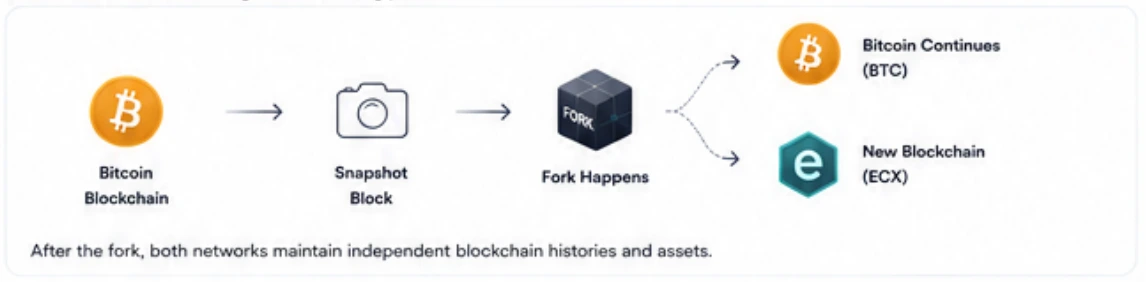
A Bitcoin hard fork generally begins from a defined point in the Bitcoin blockchain.
The new network can use Bitcoin balances recorded at a particular block height to establish corresponding balances on the new blockchain. This point is commonly described as a snapshot.
Once the networks separate, they maintain independent blockchain histories going forward.
What Is a Bitcoin Snapshot?
A Bitcoin snapshot records eligible BTC balances at a specific blockchain block height.
If a new blockchain uses that snapshot for distribution, Bitcoin addresses holding eligible balances at the snapshot may receive corresponding balances on the new network according to its protocol rules.
The snapshot does not move Bitcoin. It simply provides the new blockchain with a record that can be used to determine initial balances.
What Happens to Your Bitcoin After a Fork?
Your Bitcoin remains on the Bitcoin network.
A hard fork does not require BTC to be converted, exchanged or destroyed.
After the fork, two assets may exist: BTC on the Bitcoin network and the new asset on the forked blockchain.
If you control the private keys associated with an eligible Bitcoin address, those same credentials may also provide access to the corresponding balance created on the new blockchain, depending on the fork's design.
Why Coin Splitting and Replay Protection Matter
When a new blockchain shares Bitcoin's transaction history and compatible transaction rules, transactions created for one chain may potentially be valid on the other chain.
This is known as transaction replay.
Without appropriate protection, a transaction intended to move BTC on Bitcoin could potentially cause the corresponding coins to move on the forked blockchain as well.
Coin splitting separates the assets so they can be managed independently.
ECX Replay Protection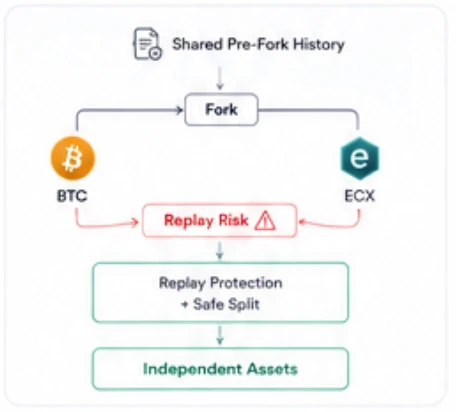
Why Are Bitcoin Hard Forks Created?
Bitcoin hard forks can be created for many reasons.
A new network may introduce different technical features, consensus rules, transaction models, governance structures or development goals while using Bitcoin's existing blockchain history as its starting point.
After the fork, the new blockchain develops independently. Its future does not depend on Bitcoin adopting the same protocol changes.
How Does the eCash (ECX) Bitcoin Fork Work?
eCash (ECX) is a new blockchain network that uses snapshots of Bitcoin balances to establish corresponding ECX balances.
Unlike a fork that transitions immediately to a permanent network, the ECX launch takes place in three stages: Alpha, Beta and Mainnet.
Alpha and Beta are testing stages with practice ECX. The Mainnet snapshot establishes permanent ECX balances.
ECX Alpha, Beta and Mainnet Snapshots
ECX Alpha Testnet
Practice ECXECX Beta Testnet
Practice ECXECX Mainnet
Permanent ECXAlpha: The first testing stage. Bitcoin balances recorded at the Alpha snapshot establish practice ECX balances for testing the network and compatible software.
Beta: A second testing stage before the permanent network begins.
Mainnet: The Mainnet snapshot establishes permanent ECX balances.
Who Can Receive ECX From the Bitcoin Fork?
Bitcoin addresses holding eligible BTC balances at the relevant ECX snapshot blocks receive corresponding ECX balances according to the network rules.
If you control the private keys or Recovery Phrase associated with an eligible Bitcoin wallet, you can use compatible ECX wallet software to access the corresponding ECX.
If your BTC is held by an exchange or another custodial service at a snapshot, the custodian controls the relevant private keys. In that situation, access to ECX depends on whether the service supports the eCash fork and distributes the corresponding ECX to its users.
Check Your Bitcoin Address for ECX
You can check a public Bitcoin address to see whether it has an ECX allocation associated with a snapshot.
Only a public BTC address is required for an eligibility check.
Never enter a Recovery Phrase or private key into a public address checker.
Check Your Bitcoin Address for ECX
The eligibility checker is an external service and is not operated by ECXIUM.
How ECXIUM Handles the ECX Fork
ECXIUM is a non-custodial web wallet designed specifically for eCash (ECX).
If you control an eligible Bitcoin wallet, you can import it into ECXIUM using a compatible Recovery Phrase or WIF private key.
ECXIUM detects the corresponding ECX and automatically handles safe coin splitting and replay protection where required.
There is no separate manual Split button or Claim transaction to construct.
During Alpha and Beta, ECXIUM clearly identifies the active ECX testnet so practice balances are not confused with permanent Mainnet ECX.
How to Claim ECX Split BTC and ECXBitcoin Hard Fork vs ECX Fork
| Typical Bitcoin Hard Fork | eCash (ECX) | |
|---|---|---|
| Origin | Bitcoin blockchain | Bitcoin blockchain |
| Snapshot | Project dependent | Alpha, Beta & Mainnet |
| Original BTC | Remains on Bitcoin | Remains on Bitcoin |
| New asset | Separate asset | ECX |
| Testing stages | Project dependent | Alpha & Beta |
| Permanent network | Project dependent | ECX Mainnet |
| Replay protection | Depends on protocol | Required for safe separation |
| ECXIUM handling | - | Automatic safe split & replay protection |
FAQ
Is Bitcoin affected by a hard fork?
Bitcoin continues operating on its own blockchain. A new forked blockchain operates independently according to its own protocol rules.
Do I lose my Bitcoin after a fork?
No. A hard fork does not remove your BTC from the Bitcoin blockchain.
What is a Bitcoin snapshot block?
A snapshot block records Bitcoin balances at a particular block height. A forked blockchain can use those balances to determine corresponding balances on the new network.
Does a Bitcoin fork double my Bitcoin?
No. Your BTC balance on Bitcoin does not double. A separate asset may be created on the new blockchain according to the fork's distribution rules.
Can a transaction be replayed after a Bitcoin fork?
Potentially, depending on the protocol. If transactions are valid on both chains, a transaction intended for one network may also be accepted by the other. Replay protection and coin splitting are used to prevent this.
Does ECX use one Bitcoin snapshot?
No. The ECX launch uses three stages: Alpha around block ~963,648, Beta around 967,680 and Mainnet around ~973,728.
Are Alpha and Beta ECX permanent?
No. Alpha and Beta use practice ECX for testing. Permanent ECX is established at the Mainnet snapshot.
What happens to my BTC when I receive ECX?
Your BTC remains on Bitcoin. ECX exists separately on the eCash network.
Do I need to manually split BTC and ECX with ECXIUM?
No manual split is required when using ECXIUM. ECXIUM automatically handles safe coin splitting and replay protection when an eligible Bitcoin wallet is imported.
Can I receive ECX if my Bitcoin is on an exchange?
If an exchange or custodial service controls the private keys at a snapshot, access to the corresponding ECX depends on whether that service supports the fork and distributes ECX to its users.